September 2, 2020 NHTSA CAMPAIGN NUMBER: 20V536000
Die Cast Pedal Plate Casting Issue/FMVSS 121
A dislodged brake pedal would be inoperable, increasing a risk of a crash.
NHTSA Campaign Number: 20V536
Manufacturer Volvo Trucks North America
Components SERVICE BRAKES, AIR
Potential Number of Units Affected 15,156
Summary
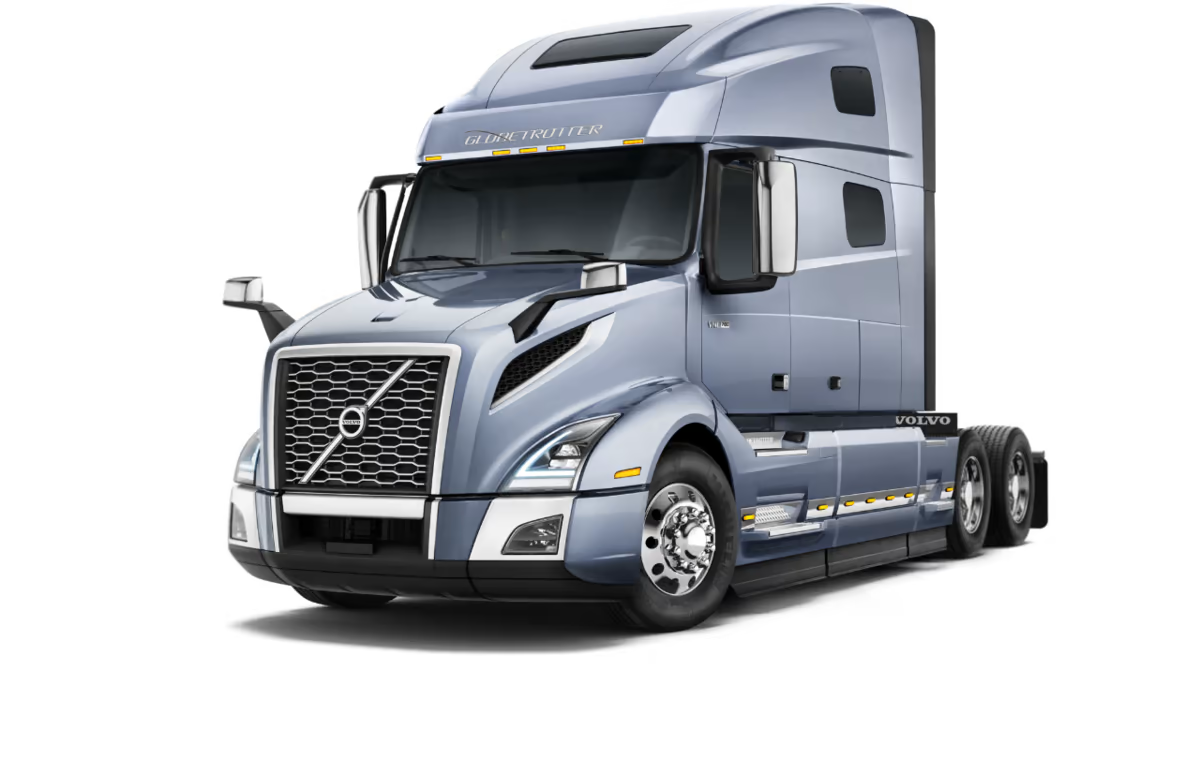
Volvo Trucks North America (Volvo Trucks) is recalling certain 2020-2021 VAH, VHD, VNL and VNR vehicles. The die cast pedal plate may break at one of its attachment points, possibly resulting in the brake pedal dislodging. As such, these vehicles fail to comply with the requirements of Federal Motor Vehicle Safety Standard number 121, “Air Brake Systems.”
Remedy
Volvo Trucks will notify owners, and dealers will inspect and replace the pedal plates if required, free of charge. The recall began October 7, 2020. Owners may contact Volvo Trucks customer service at 1-800-458-1552. Volvo Truck’s number for this recall is RVXX2004.
Notes
Owners may also contact the National Highway Traffic Safety Administration Vehicle Safety Hotline at 1-888-327-4236 (TTY 1-800-424-9153), or go to www.safercar.gov.
Volvo Trucks
Uptime
Recall Alerts
| To:
Dealer Principals | Region: ☒U.S. ☒CAN | Bulletin: SRA-V20-04
Date: September 18, 2020 Valid to: N/A Action Required? ☒Yes ☐No |
From: Gerard Hones, Regulatory Specialist Government Reporting
Subject: Safety Recall RVXX2004, Pedal Plate
Description of Defect:
The die cast pedal plate may have a casting process issue that can result in failure of the pedal plate at one of three attachment ears that support the brake pedal shaft. If the attachment ear fails and the brake pedal shaft works its way out of one of the two other attachment holes, the brake pedal may dislodge, making the brake pedal inoperable. An inoperable brake pedal presents a risk of a vehicle crash.
There are no reports of an inoperable brake pedal or a vehicle crash related to this issue. Volvo considers this a proactive measure to protect the public and Volvo’s customers from the potential risk associated with this defect.
Models/ Model Years Affected:
Volvo: 2020 & 2021 VAH, VHD, VNL, & VNR model vehicles manufactured from October 15, 2019 through August 14, 2020.
Vehicle Quantities:
13,264 (Canada 1,829, Mexico 259, and 11,176 USA)
Dealer’s Responsibility:
The National Traffic and Motor Vehicle Safety Act and Canadian Motor Vehicle Safety Act requires dealers to ensure that all new and used vehicles are free of safety defects and comply with all relevant safety standards at the time of delivery to the consumer.
Dealers should make their personnel aware of the safety recall. In the event that a dealer has a vehicle included in the safety recall in their inventory to be sold, the condition must be corrected before releasing it to a customer.
Release Schedule:
- The vehicle list is posted on the Trucks Dealer Portal.
- The inspection procedure is posted on the Trucks Dealer Portal.
- Owner notification letters will be mailed by October 30, 2020
If you have questions or concerns about this recall, contact the Regulatory Affairs Department at [email protected].
Q: Are the vehicles safe to operate prior to an inspection/fix?
- Yes
- An initial failure of the pedal plate does not make the brakes The plate has multiple attachment points for the brake pedal shaft.
- We expect the driver will feel looseness in the brake pedal before the problem can progress to the point where the brake pedal would become inoperable.
- We do not expect a high percentage of vehicles being recalled to have the issue, based on review of over 2,000 parts.
- To our knowledge, the only instance in which the problem occurred was during an aggressive test that involved repeatedly hitting the brakes, and even then, the pedal did not become inoperable during the test. Rather, the driver felt looseness in the pedal.
Q: How/when, will you advise owners?
- Owners will be notified by first class mail by October 30.
- We will inform the owners to schedule an appointment with an authorized Volvo Service Provider, who will inspect and/or repair the vehicle free of charge.
Q: What should customers with an affected vehicle do?
- Customers with affected vehicles should have their vehicle(s) inspected/ repaired by an authorized Volvo Service Center once notified by Volvo.
Q: What is the fix?
- Inspect the pedal plate and replace it if necessary. The inspection procedure is posted on the Trucks Dealer Portal.
- Repair instructions will become available the week of September 21, 2020.
Q: What is the cause?
- A casting process issue (i.e. a manufacturing defect) at our supplier’s forging plant
Q. What should I do with new vehicle inventory that has not been sold or delivered to owners?
- You should use the inspection procedure provided on the Trucks Dealer Portal to determine whether the pedal plate requires replacement.
- Vehicles that pass the pedal plate inspection can be released to customers.
- Vehicles found with pedal plates that contain the defect must be repaired before they can be released to a customer.
Q. Are pedal plates available and if/not when will they be available?
- The part is currently blocked until sufficient stock is available in the PDC. A VOR order will need to be placed if required to satisfy a vehicle off road situation.
Q. What do I do with pedal plates in my parts inventory?
- The parts in inventory should be inspected per the inspection criteria, and if found suspect, a parts warranty claim is to be filed. The part will be triggered to be returned to TMAC following normal processes.
Q. What do I do with pedal plates that are defective that are removed from affected vehicles?
- Claims filed for replacement of a defective pedal plate will be triggered to be returned to TMAC following normal processes.
SAFETY RECALL
VOLVO Trucks North America
Date
09/20
Number
RVXX2004
Pedal Carrier Date Code Inspection
SAFETY RECALL INFORMATION
(September 2020)
Volvo Trucks has determined that a defect that relates to motor vehicle safety exists in certain VN model vehicles fitted with the part 82754992 with the date code September, 2019 OR October, 2019.
The die cast pedal plate may have a casting process issue that can result in failure of the pedal plate at one of three attachment ears that support the brake pedal shaft. If the attachment ear fails and the brake pedal shaft works its way out of one of the two other attachment holes, the brake pedal may dislodge, making the brake pedal inoperable. An inoperable brake pedal presents a risk of a vehicle crash.
There are no reports of an inoperable brake pedal or a vehicle crash related to this issue.
Volvo considers this a proactive measure to protect the public and Volvo’s customers from the potential risk associated with this defect.
VEHICLES AFFECTED
Volvo: 2020 & 2021 VAH, VHD, VNL, & VNR model vehicles manufactured from October 15, 2019 through July 24, 2020.
VEHICLE QUANTITIES:
13,209 (Canada 1,825, Mexico 257, and 11,127 USA)
SOLUTION
Follow Inspection, Test and Repair procedures as necessary in this Recall.
INSPECTION PROCEDURE:
DECOMMISSIONING THE TRUCK FOR REPAIR
DANGER
Do not attempt to repair or service this vehicle without having sufficient training, the correct service literature and the proper tools. Failure to follow this could make the vehicle unsafe and lead to serious personal injury or death.
NOTE
Wear safety glasses during the duration of this repair to protect from possible inadvertent glass breakage
1. Secure the vehicle for service by parking on a flat and level surface.
2. Apply parking brake.
3. Place the transmission in neutral or park.
4. Install the wheel chocks.
5. Disconnect the cable from the battery’s negative (ground) terminal.
6. Unlatch and raise the hood.
7. Remove the splash shields.
8. Loosen the adjustment nut.
9. Remove the release cable.
10. Pull back the passenger side panel to gain access for the center panel.
11. Remove the screws.
12. Remove the panel.
Note: Use caution not to damage the panel.
13. Remove the screws.
14. Remove the cover.
15. Remove the screw cover.
16. Remove the screws.
17. Remove the handle.
18. Remove the screws.
19. Remove the panel.
20. Disconnect hood release cable.
21. Remove the screws.
22. Remove the panel.
23. Check the date code on the pedal carrier.
Note: A) Find the row which indicates the year.
For example: the row under 18 is 19 and indicates year 2019.
B) Count the number of dots or the position of the dots. For example: One dot in the first position is January.
Photo shows an example of September, 2019 date code
24. If the date code shows 9 or 10 dots in row 19 this indicates September, 2019 or October, 2019. Then continue to the Test Procedure next.
25. If date code IS NOT 9 or 10 dots, then replace all removed components in reverse order and return the truck to service. File claim as Part “A” Only.
TEST PROCEDURE:
1. Start the vehicle and allow air pressure to build to 120 psi or connect to shop air.
2. Perform 12 simulated emergency stops.
3. Remove the bolt.
4. Pull the brake pedal shaft out enough to inspect casting.
5. From the driver’s perspective; thoroughly inspect both sides of the right most ear for possible defects. The defects seem to resemble a crack with some discoloration. Use examples below to determine defective parts See Fig. 1 and Fig. 2 (circled line/cracks show the signs of defective parts)
6. Before continuing, create an ARGUS case with RVXX2004 in the Summary field, choose Reliability in the App/Service field and add photos of the right most, mounting ear from both sides of the ear. In the Description field indicate whether the Pedal Carrier Plate was replaced or there were no defects found.
7. If defects are found, then continue to the Repair Procedure next.
8. If defects are NOT found then replace all removed components in reverse order and return the truck to service. File claim as Part “A” + Part “B” Only.
REPAIR PROCEDURE:
1. Drain the compressed air tanks.
Note: Make sure the steering wheel is straight and the front wheels are pointed straight ahead.
3. Remove the screws.
4. Remove the column cover mounting bracket.
5. Remove dash support rod.
6. Mark the position.
7. Remove the screw and the nut.
8. Remove the steering shaft.
9. Remove the tie.
10. Remove the sleeve bushing.
11. Remove the screws.
12. Remove the boot.
13. Mark the position.
14. Remove the screw and nut.
15. Remove the steering shaft.
16. Remove the steering shaft.
17. Remove upper left side cowl screws.
Note: Install a small wedge to make an access slot.
18. Remove the screws.
19. Remove left side hood latch with bracket.
20. Label and take photos of all electrical and air connections on the pass-through.
Electrical and Pneumatic connections inside the cab
Electrical and Pneumatic connections outside of the cab (Engine compartment)
21. Disconnect the electrical connections and airlines.
22. Remove the nuts.
23. Remove brake valve leaving all air lines attached.
24. Remove all electrical and air connections inside and outside of the truck strap everything up and out of the way.
25. Remove the nuts.
26. Pull the pedal plate away from the firewall.
27. Remove the nut.
28. Remove the bracket.
29. Remove the brake pedal and brake pedal shaft from the pedal plate.
Note: The pedal plate will not clear the steering column brackets without removing the brake pedal.
30. Transfer all parts to the new pedal plate.
31. Apply Butyl tape to plate along the outside of flanges.
32. Install the pedal plate into the foot well, but not attached to firewall yet.
33. Install the brake pedal shaft and brake pedal on the pedal plate.
34. Install the bracket. (No specific adjustment is required)
35. Install the screw.
36. Install the pedal plate onto the firewall
37. Install the nuts.
38. Connect the electrical connections and airlines.
Electrical and Pneumatic connections inside the cab
Electrical and Pneumatic connections outside of the cab
39. Install the foot brake valve.
40. Install the mounting nuts.
41. Torque tighten the nuts.
| Tightening torque | |
| Footbrake valve, nut | 24 ±4 Nm |
42. Install the steering shaft.
43. Install the steering shaft as marked.
44. Install the screw and nut.
45. Torque tighten the screw.
| Tightening torque | ||
| Steering shaft, joint, screw | 1. | 30 ±3 Nm |
| 2. | 60 ±5° |
46. Install the boot.
47. Install the screws.
48. Torque tighten the screws.
| Tightening torque | |
| Screw | 6 ±1 Nm |
49. Install the sleeve bushing.
50. Install the tie.
51. Install the steering shaft as marked.
52. Install the screw and nut.
53. Torque tighten the screw.
| Tightening torque | ||
| Steering shaft, joint, screw | 1. | 30 ±3 Nm |
| 2. | 60 ±5° |
54. Install the upper left side cowl screws.
55. Torque tighten the screws.
| Tightening torque | |
| Screw | 24 ±4 Nm |
56. Install the left side hood latch with bracket.
57. Install the screws.
58. Install the column cover mounting bracket.
59. Install the screws.
60. Remove dash support rod.
61. Install the screw.
62. Install the panel.
63. Install the screws.
64. Torque tighten the screws.
| Tightening torque | |
| Screw | M4 |
| 1.5 ±0.5 Nm | |
65. Install the hood release cable.
Note: Install the cable tie as needed.
66. Install the panel.
67. Install the screws.
68. Torque tighten the screws.
| Tightening torque | |
| Screw | M4 |
| 1.5 ±0.5 Nm | |
69. Install the handle.
70. Install the screws.
71. Torque tighten the screws.
| Tightening torque | |
| Screw | M8 |
| 24 ±4 Nm | |
- 72. Install the screw cover.
73. Install the cover.
74. Install the screws.
75. Torque tighten the screws.
| Tightening torque | |
| Screw | M4 |
| 1.5 ±0.5 Nm | |
76. Install the panel.
77. Install the screws.
78. Torque tighten the screws.
| Tightening torque | |
| Screw | M6 |
| 10 ±1.5 Nm | |
79. Push the passenger side panel to the original position.
80. Route the cable to the latch.
Note: Install the cable ties as needed.
81. Tighten the adjuster.
Note:
a) Check release cable adjustment and readjust if necessary.
b) Check the hood for operation.
82. Connect the cable to the negative terminal.
83. Start the engine.
84. Idle engine until the pneumatic system is at operating pressure.
Note: The pneumatic system is full when the compressor unloads.
85. Check for leaks.
86. Lower the hood.
Note: Ensure that the hood is latched.
87. Remove the wheel chocks.
Note:
Upon completion of the recall please forward these instructions to your warranty administrator for proper claim filing and reimbursement.
REIMBURSEMENT:
Claim Instructions:
If Inspection ONLY was completed and specific date code on the Pedal Carrier Plate was NOT found, (See Pg 6, Step 25)
Labor code for the claim is:
5240-06-09-01 “A” Only
NOTE: When the Pedal Carrier has NOT been replaced. Under claim “Material” for Causal part….”REPAIRED” must be selected, see below. ALSO WHEN ONLY INSPECTION was completed.
If Inspection AND Functional Test has been completed but no defect found, (See Pg 8, Step 9)
Labor codes for the claim are:
5240-06-09-01 “A” +
5240-08-09-01 “B”
NOTE: When the Pedal Carrier has NOT been replaced. Under claim “Material” for Causal part….”REPAIRED” must be selected, see below.
If Inspection, Functional Test AND Repair has been completed
Labor codes for the claim are:
5240-06-09-01 “A” +
5240-08-09-01 “B” +
5240-03-09-01 “C”
NOTE: When the Pedal Carrier has been removed and replaced. Under the claim “Material” for Causal part….“REPLACED” must be selected, see below.
| This repair is covered by an authorized Safety Recall campaign. Reimbursement is obtained through the normal claim handling process. | |
| Claim Type (used only when uploading from the Dealer Business System) | R |
| Recall Status | |
| Vehicle repaired per instructions | Modified per instructions |
| Labor Codes | |
| Part A:
Primary Labor Code, Pedal Plate Date Code Inspection | 5240-06-09-01
0.6 Hrs |
| Part B:
Additional Labor Code, Pedal Plate Functional Test | 5240-08-09-01
0.4 Hrs |
| Part C:
Additional Labor Code, Pedal Plate Replacement | 5240-03-09-01
3.5 Hrs |
| Parts Disposition | Replaced parts will be triggered for return |
| Causal Part | 82754992 |
| Authorization Number | C6619 |
Note: Dealers are to perform Safety Recall Campaigns on all subject vehicles at no charge to the vehicle owner regardless of mileage, age of vehicle or ownership (original purchaser or subsequent purchasers). Whenever vehicles are subject to a safety recall are brought to your dealership for service, or taken into your dealership vehicle inventory, it is strongly recommended that every effort be made to perform the recall correction before the vehicle is sold or released to the owner.
IMPORTANT SAFETY RECALL RVXX2004
NHTSA RECALL # 20V-536
DEAR VOLVO TRUCK OWNER:
This notice is sent to you in accordance with the requirements of the National Traffic and Motor Vehicle Safety Act.
Volvo Trucks North America has decided that a defect, which relates to motor vehicle safety exists in certain 2020 and 2021 VAH, VHD, VNL and VNR model vehicles manufactured from October 15, 2019 through August 14, 2020.
SAFETY DEFECT:
The die cast pedal plate may have a casting process issue that can result in failure of the pedal plate at one of three attachment ears that support the brake pedal shaft. If the attachment ear fails and the brake pedal shaft works its way out of one of the two other attachment holes, the brake pedal may dislodge, making the brake pedal inoperable.
SAFETY RISK:
An inoperable brake pedal presents a risk of a vehicle crash.
PRECAUTIONS YOU CAN TAKE:
There are no precautions you can take other than having your vehicle inspected and repaired if needed by a Volvo Parts and Service Center.
TIME REQUIRED FOR THE REPAIR:
The time required to inspect/ repair your vehicle is approximately 1 hour.
WHAT YOU SHOULD DO:
You should contact the nearest Volvo Parts and Service Center and make an appointment. The dealer will inspect the pedal plate and replace it if needed.
You can locate the closest Volvo Parts and Service Center by going on line to https://www.volvo.com/trucks/na/en-us/dealers/ and selecting “Dealer Locator” or by calling our toll-free number: 1-800-52-VOLVO (1-800-528-6586).
NOTICE REGARDING LEASED VEHICLES:
If you are a Lessor of vehicles subject to this Notice, you have an obligation under Federal Law to provide a copy of this Notice to all Lessees within 10 days of your receipt of this Notice. Further, you must maintain a record, which identifies the Lessee(s) to whom you send a copy of this letter, the date you send this letter and the Vehicle Identification Number(s) of the vehicle that you have leased to that lessee. For purposes of this Notice, the term Lessor means: a person or entity that is the owner, as reflected on the vehicle’s title, of any five or more leased vehicles (as defined in CFR Section 577.4), as of the date of notification by the manufacturer of the existence of a safety-related defect or non-compliance with a Federal Motor Vehicle Safety Standard in one or more of the leased motor vehicles.
OWNER RECALL RESPONSE CARD:
The enclosed “Notice of Vehicle Recall” identifies your vehicle. If you no longer own the vehicle, please help us update our records by completing the “Vehicle Disposition Record” portion of the enclosed postage-free Notice of Mandatory Safety Campaign card and mailing it back to us.
ASSISTANCE/
COMPLAINTS:
Volvo Trucks North America
Regulatory Affairs Department,
P.O. Box 26115
Greensboro, NC 27402-6115
vtna.regulatoryaffairs@volvo.com
You may also submit complaints to the Administrator of the National Highway Traffic Safety Administration (1200 New Jersey Avenue, S.E., Washington DC 20590 or call the toll-free Auto Safety Hot Line at 1-888327-4236 (TTY: 1-800-424-9153), or go to https://www.safercar.gov if you believe that Volvo has failed to remedy the defect without charge, or has failed to remedy the vehicle within 60 days of the owners first tender to obtain repair following the earliest time that parts are available.
If you have previously paid for repairs as a result of this issue, you may be entitled to recovery of those expenses.
PRE NOTIFICATION REMEDIES:
Submit copies of all documentation supporting your claim according to the rules specified in the “General Plan for Reimbursement of Prenotification Remedies” provided in this mailing.
We regret any inconvenience this may cause to your operation, but hope you will appreciate our sincere efforts to demonstrate Volvo’s commitment to provide our customers with the best possible product.
VOLVO TRUCKS NORTH AMERICA
RVXX2004_OWNER_LTR_US
October 2020
8 Affected Products
Vehicles
16 Associated Documents
ISSUED Owner Notification Letter(Part 577)
RCONL-20V536-5205.pdf 152.494KB
Recall Quarterly Report #3, 2021-2
RCLQRT-20V536-9824.PDF 211.432KB
Recall Quarterly Report #4, 2021-3
RCLQRT-20V536-0021.PDF 211.432KB
Recall Quarterly Report #1, 2020-4
RCLQRT-20V536-6608.PDF 211.24KB
Recall Quarterly Report #2, 2021-1
RCLQRT-20V536-5062.PDF 211.24KB
Recall 573 Report- Amendment 2
RCLRPT-20V536-2314.PDF 237.918KB
Recall 573 Report- Amendment 1
RCLRPT-20V536-9115.PDF 237.91KB
Miscellaneous Document- Initial Inspection
RMISC-20V536-9387.pdf 853.548KB
Recall Acknowledgement
RCAK-20V536-6344.pdf 244.735KB
Recall 573 Report-Amendment 1
RCLRPT-20V536-1953.PDF 237.908KB
Defect Notice 573 Report
RCLRPT-20V536-9586.PDF 237.875KB
Manufacturer Notices(to Dealers,etc)
RCMN-20V536-6225.pdf 430.144KB
Remedy Instructions and TSB
RCRIT-20V536-4142.pdf 1765.063KB
Recall Quarterly Report #1, 2020-4
RCLQRT-20V536-7513.PDF 211.145KB
Recall Quarterly Report #3, 2021-2
RCLQRT-20V536-2126.PDF 211.329KB
Recall Quarterly Report #5, 2021-4
RCLQRT-20V536-6252.PDF 211.542KB
Latest Recalls Documents

- Fits 16-1/2" Diameter x 7" Wide Meritor 'Q Plus' Quick Change Brakes
- New Brake Shoes (No Core Charge)
- Shoe FMSI Number: 4707
- Has The Plus (+) Symbol In The Brake Shoe Table
- Includes Two Brake Shoes & One Hardware Kit

- Replace part numbers - E-11800, KSR2034707QP, SB4707R690, GG470701J, SB4707R931, GG4707QJ, MRK4707QH20S, GG4707QN, S-25290, KSMA2124707QP, 4707QP, E-2769SHD, K329, NL1625, CQ66867, E2769SHDR
- Heavy Duty Application – Designed for air brake drum systems on commercial trucks, trailers, and buses
- 4707 4707Q Size – 16.5” x 7” brake shoes with premium 23K friction lining for reliable braking performance. Direct replacement for 4707Q+ / Q Plus brake assemblies
- Complete Box Kit – Includes 2 brand-new brake shoes and all necessary hardware components for installation
- Durable Construction – Manufactured with high-quality materials for consistent braking and extended service life

- Cross References: PR4515Q, 620-PR4515Q, HD4515Q, HD4515QKIT, 510-+HD4515QKIT, 4515EZT, A913222S1293, R4515, 01128, 1128, M1421, 21898, 01128, 4515Q, 67379, L1478, 67379, A3222S1293, A913222S1293, R4515, 4515EST, 21898, 4515Q, 7A3127, G2058987
- Fits 16-1/2" Diameter By 7" Wide Meritor 'Q' Quick Change Air Brakes
- Shoe FMSI Number: 4515E
- New Brake Shoes (No Core Charge)
- Includes Two Air Brake Shoes & One Hardware Kit
- Cross References: E5503, E-5503, A193222D2006, 01008, M3189, TDAA3222D2006, A3222L2066, 4707D, 4707Q, L3011, A193222D200, R4707, 21855, 4707R, 4707XT, HV774707QG, XSEG24707QP
- Fits 16-1/2" Diameter x 7" Wide Meritor 'Q Plus' Quick Change Brakes
- New Brake Shoes (No Core Charge)
- Shoe FMSI Number: 4707
- Has The Plus (+) Symbol In The Brake Shoe Table

- Cross References: E9027, E-9027, R700017, 1443E, L3016, 818569, 010801, PR1443, 620-PR1443
- Fits 15" Diameter x 4" Wide Eaton Extended Service Front Brakes
- Two Brake Shoes & One Hardware Kit Included, Services One Wheel
- This is The Extended Service Eaton 15" x 4" Brake Shoe
- This is NOT The Eaton 15" x 4" Standard Brake Shoe Version
This product presentation was made with AAWP plugin.